
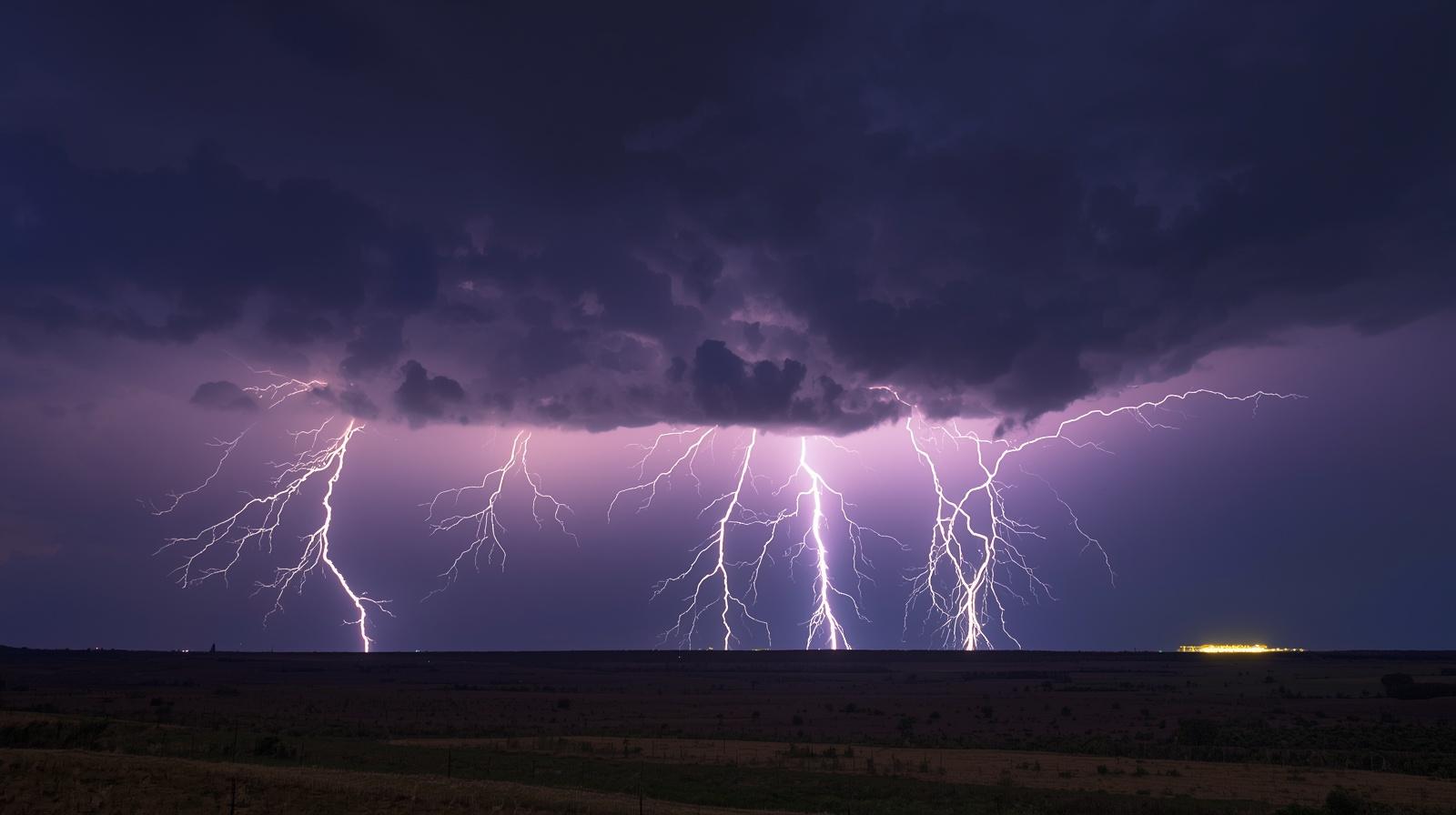
Lightning is a sudden and violent natural discharge phenomenon. It usually appears as a brilliant streak of light cutting across the sky, either between clouds or from cloud to ground. Its shape is not a single straight line but often shows branching, bending, or tree‑like divisions, giving it a highly irregular appearance.
In an instant, lightning releases immense energy and brightness, accompanied by intense heat and powerful electric currents. Its glare is dazzling enough to illuminate the entire sky for a brief moment; at the same time, its current can scorch surfaces, shatter objects, and even ignite fires.
Such a spectacular yet dangerous force of nature raises the question: how does lightning form, and under what conditions is it triggered?
Atoms are the fundamental units of matter. At the center lies the nucleus, which contains positively charged protons and electrically neutral neutrons; electrons, meanwhile, occupy the space outside the nucleus, orbiting in different energy levels. The number of protons determines the type of element, neutrons influence the stability of the atom, and electrons serve as the key agents in the atom’s interactions with the external world.
The relationship between protons and electrons is rooted in the interaction of electric charges. Protons carry positive charge, electrons carry negative charge, and the strong attraction between them binds electrons around the nucleus, creating a stable atomic structure. Without this attraction, electrons could not remain within the atom, and atoms themselves would not exist.
The process by which an electric field drives electrons to flow and form current can be imagined as an invisible force unfolding within a conductor. When a voltage is applied across the ends of a conductor, it creates an uneven distribution of charges, thereby establishing an electric field. This field exerts a continuous force on electrons, compelling them to move in a specific direction rather than merely engaging in random thermal motion.
In metallic wires, electrons are inherently free to move, but without an external force their motion is disordered and does not produce current. Once an electric field is present, electrons are driven into an orderly drift.
Although the drift velocity of individual electrons is extremely slow, the sheer number of electrons ensures that the collective effect is the formation of a stable current. This current can rapidly transmit energy and signals, making electricity a cornerstone of human civilization.
A cumulonimbus cloud is a massive, towering cloud formation that often rises skyward like a giant pillar. Its development originates from powerful updrafts: when the ground is heated, air rapidly ascends carrying abundant water vapor. As the air rises, the vapor cools and condenses into droplets or ice crystals, causing the cloud to build upward. With sustained updrafts, the cloud can grow to immense heights, sometimes even penetrating the top of the troposphere.
Cumulonimbus clouds are characterized by their dense structure and dark base, while their tops often spread into mushroom‑shaped or anvil‑like forms. Inside, they contain vast amounts of water droplets and ice crystals, accompanied by vigorous air currents. These conditions make them prone to producing lightning, torrential rain, hail, and even tornadoes.
Within a cumulonimbus cloud, droplets and ice crystals of different sizes collide continuously in the turbulent air. These collisions are not merely mechanical contacts but involve the transfer of electric charge. Larger ice particles or hailstones tend to acquire negative charge by capturing electrons during collisions, while smaller ice crystals are more likely to lose electrons and thus become positively charged.
Under the combined influence of gravity and air currents, negatively charged larger particles sink toward the cloud base, while positively charged smaller particles are carried upward to the cloud top. This layered movement gradually establishes charge separation within the cloud: positive charges accumulate at the top, negative charges at the base.
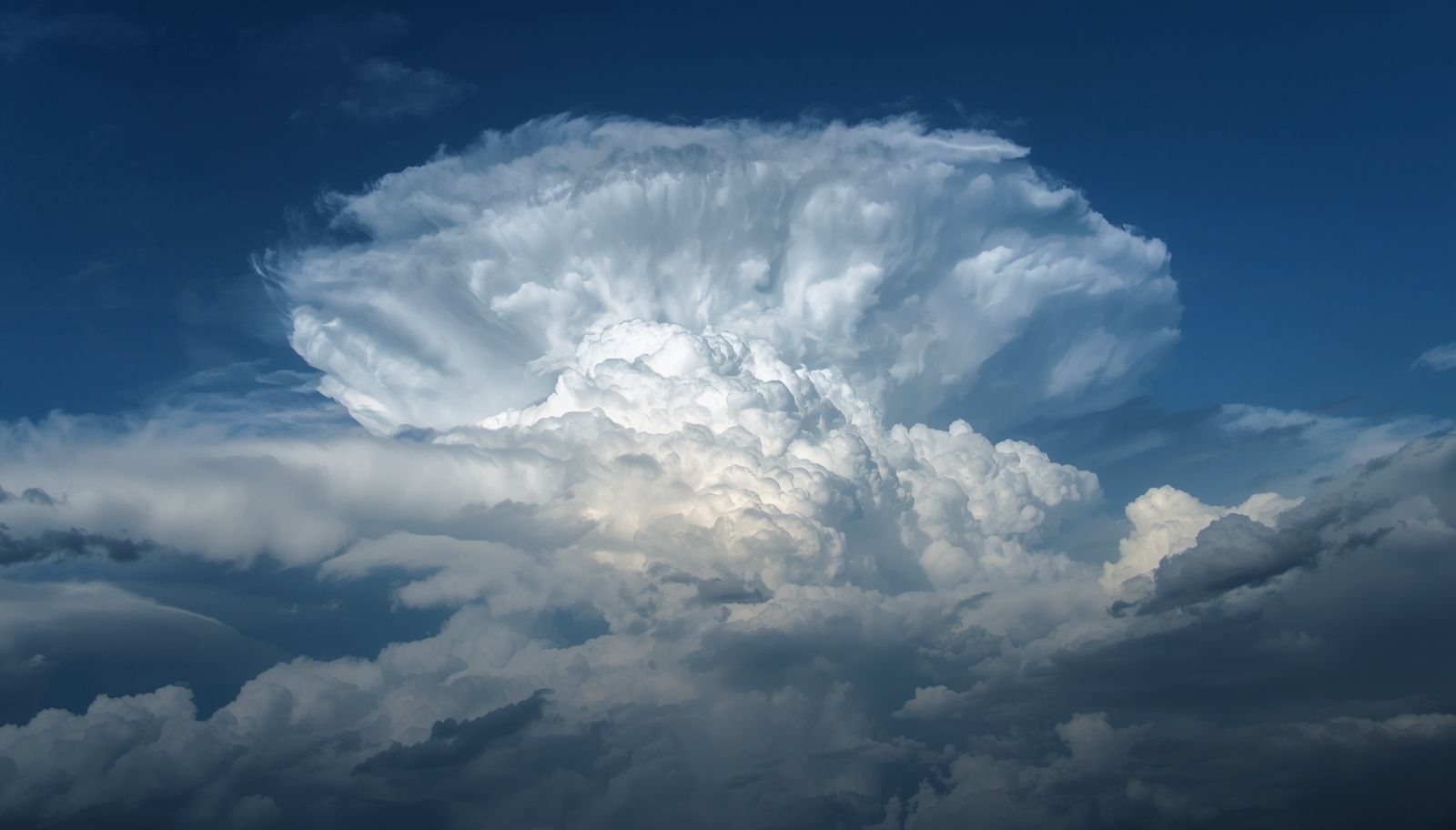 Cumulonimbus cloud
As the base of a cumulonimbus cloud gradually accumulates large amounts of negative charge, it exerts a significant influence on the ground. The negative charges at the cloud base act through the electric field, inducing opposite positive charges on the surfaces of objects below.
This induction does not mean the objects actively acquire charge; rather, the strong electric field forces electrons within them to redistribute, driving electrons deeper or outward and leaving positive charge concentrated at the surface. The result is a vast potential difference between the ground and the cloud base.
With the electric field continually intensifying, air molecules begin to be pulled apart and progressively ionized, releasing free electrons and ions. These charged particles reduce the insulating capacity of air, opening the possibility of conduction.
During this process, the cloud base emits branching “downward leaders,” tentative discharge paths that extend step by step toward the ground. At the same time, the positive charges on the ground generate “upward leaders,” often rising from sharp objects such as treetops, buildings, or lightning rods. When a downward leader and an upward leader meet in mid‑air, the conductive channel is instantly established.
Once the channel is formed, electrons rush along this path, releasing enormous energy. This surge of energy breaks through the insulating property of air, producing a powerful discharge phenomenon—lightning. The brilliance of lightning comes from the excitation of air molecules by the electron flow, while the accompanying thunder is caused by the shock wave generated as the air is suddenly heated and expands violently.
As electrons surge rapidly along the conductive channel, air molecules are violently struck and heated within an extremely short time to temperatures of several thousand, or even tens of thousands, of degrees. This intense heating causes the air to expand explosively, generating a powerful shock wave.
The shock wave propagates outward like an explosion, driving the surrounding air to spread in successive layers. When it reaches the human ear, it becomes what we perceive as thunder.
Because lightning often follows multiple paths with complex branching, the shock wave reflects and refracts within the air, making thunder sound at times like a deep rolling rumble and at other times like sharp cracks. Moreover, since light travels far faster than sound, we usually see the flash of lightning before hearing the thunder.
In essence, thunder is the vibration wave produced when air undergoes sudden, violent expansion due to the intense heating of lightning. It is another manifestation of the energy released by lightning, allowing us not only to see the brilliance of the discharge but also to hear the atmosphere’s resonant response.
| Stage | Description |
|---|---|
| Charge Separation within the Cloud | In a cumulonimbus cloud, droplets and ice crystals of different sizes collide in strong air currents. Electrons transfer between particles, leading to positive charges accumulating at the cloud top and negative charges at the base. |
| Ground Charge Induction | The negative electric field at the cloud base acts on the ground, inducing positive charges on the surfaces of objects and creating a vast potential difference between cloud and ground. |
| Progressive Air Ionization | As the potential difference grows, air molecules are pulled apart and ionized, releasing free electrons and ions. This reduces the insulating capacity of air. |
| Formation of Leader Discharges | The cloud base emits downward leaders, while sharp objects on the ground release upward leaders. Both extend step by step, seeking connection points. |
| Establishment of Conductive Channel | When downward and upward leaders meet, a conductive channel is instantly formed, allowing electrons to surge rapidly along the path. |
| Lightning Energy Release | The current breaks through the insulating property of air, releasing intense light and heat to form lightning, while simultaneously heating the air to generate shock waves accompanied by thunder. |
 Lightning can cause wildfires
We leverage big data to bring you the most fascinating and mind-blowing trivia. Follow us for regular updates—prepare to be amazed while leveling up your knowledge.


Bees are among the most familiar insects to humans. They flutter among flowers, collecting nectar, and often appear to embody diligence and charm. Yet behind this gentle exterior lies a harsh law of

Giant cruise ships, cargo vessels, and oil tankers may weigh hundreds of thousands of tons, yet they can still travel freely across the sea. By contrast, a stone with a volume and weight far smaller

In today’s society, motors are virtually everywhere. They drive robotic arms in factories, keeping production lines running at high speed; they power elevators and automatic doors, making urban life

The tender green of spring, the heat of summer, the golden hues of autumn, and the chill of winter—people have long grown accustomed to this cycle. Yet how many have paused to wonder: what force lies

In our daily lives and studies, we often encounter situations where we forget things. It might be that we planned to bring something before leaving home but suddenly forgot, or that a piece of

A tornado is an extreme weather phenomenon, essentially a rapidly rotating column of air formed within intense convective thunderstorm clouds. When warm, moist air collides violently with cold, dry
Christianity, Catholicism, Orthodoxy and Protestantism Christianity is a faith centered on Jesus Christ, emphasizing salvation and the relationship with God. It is also one of the religions with

Why does the skin tend to break out after staying up late? Is it because sleep deprivation disrupts some hidden rhythm, or is there an unseen signal manipulating the sebaceous glands? And why does



Follow us for quirky updates, fun discoveries, and a front‑row seat to the weird and wonderful world we live in.