

The Sun we see every day brings us warmth, light, and vitality. Yet while we take it for granted, have we ever wondered why the Sun can continuously provide energy without end? Where does its seemingly limitless fuel come from?
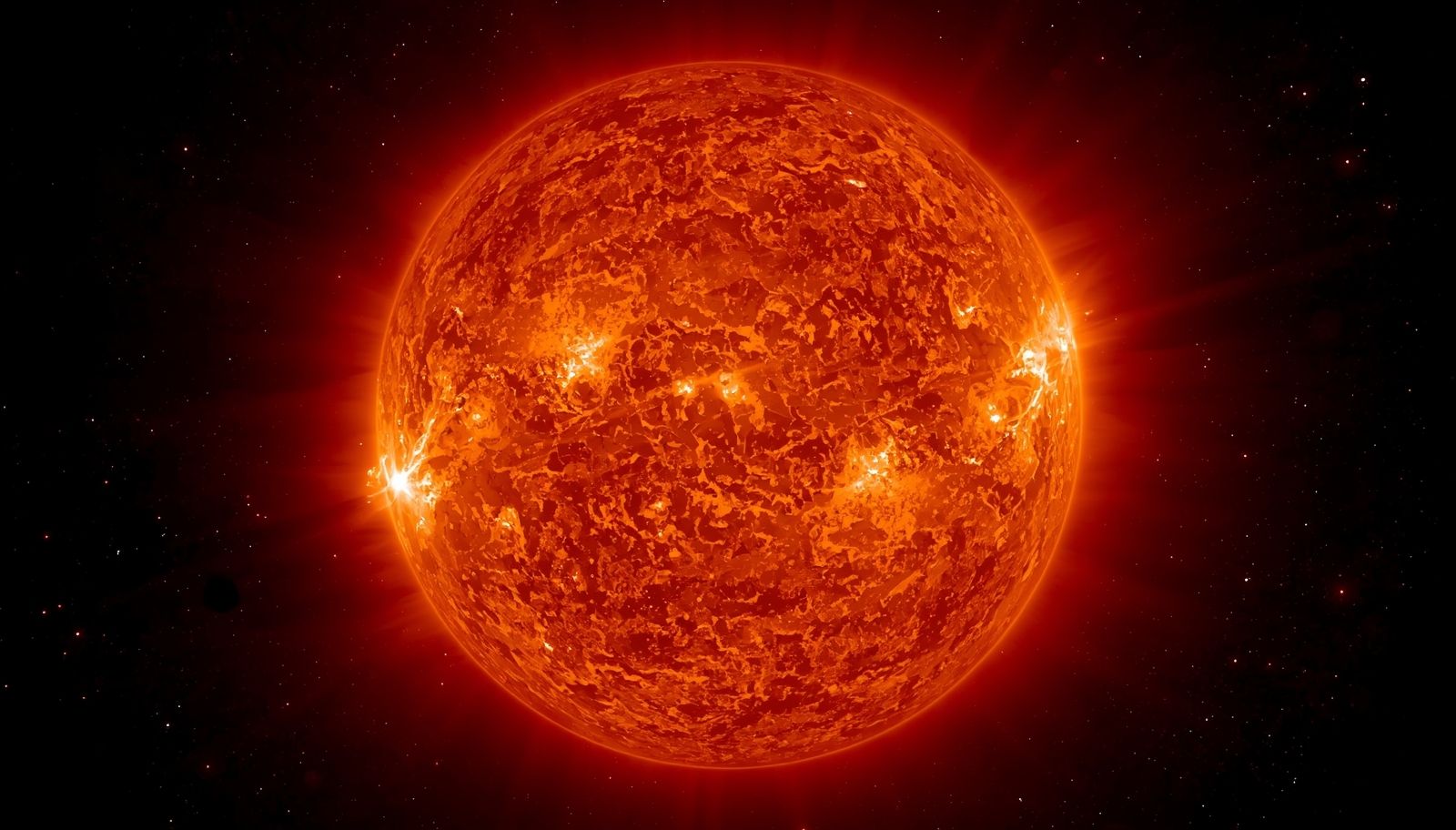
The Sun is a star located at the center of the solar system. In essence, it is a massive sphere of intensely hot gas, composed primarily of hydrogen and helium. Hydrogen makes up about three‑quarters of the Sun’s mass, while helium accounts for roughly one‑quarter. In addition, there are trace amounts of heavier elements such as carbon, nitrogen, oxygen, and iron. Although these elements exist in much smaller proportions, they still play important roles in the Sun’s structure and evolution.
The reason the Sun continues to shine and radiate heat is that nuclear fusion reactions are constantly taking place in its core. These reactions release enormous amounts of energy, which travel outward in the form of light and heat, eventually reaching the Sun’s surface and radiating into space, becoming the primary energy source for life on Earth.
Nuclear fusion is the process by which atomic nuclei combine. When the nuclei of two light elements are brought close together under extremely high temperatures and pressures, they overcome their mutual electrostatic repulsion and fuse into a heavier nucleus. The resulting nucleus has a slightly smaller mass than the sum of the original nuclei, and this tiny difference is converted into energy according to the principle of mass–energy equivalence (E=mc²). Because the square of the speed of light is such a vast number, even a minute loss of mass can yield an extraordinary amount of energy.
Inside the Sun, nuclear fusion primarily occurs through the “proton–proton chain reaction.” First, two hydrogen nuclei (protons) combine to form deuterium, releasing a positron and a neutrino. Next, the deuterium nucleus fuses with another proton to produce helium‑3. Finally, two helium‑3 nuclei combine to form helium‑4, releasing two protons in the process. This cycle repeats continuously, gradually converting hydrogen into helium.
Throughout this process, the Sun’s core temperature (around ten million degrees) and immense pressure provide the necessary conditions for hydrogen nuclei to approach each other and fuse. Each reaction releases energy, which is transported outward through the radiative and convective zones, eventually reaching the photosphere and appearing to us as sunlight.
The Sun’s brilliance is thus the direct result of ongoing nuclear fusion: hydrogen nuclei merge under extreme conditions to form helium, releasing a steady stream of energy that sustains the Sun’s stability and supports the continuation of life on Earth.
Why is the Sun able to provide energy continuously, rather than exploding like a bomb and then burning out? The reason lies in the remarkable stability of its structure and the way it releases energy.
The Sun possesses an immense mass, and under the influence of gravity, this inward pull constantly tries to compress the entire sphere of gas into a smaller volume. At the same time, the high‑temperature plasma inside the Sun generates outward pressure, pushing against gravity’s compression. When these two opposing forces reach balance, the Sun maintains a stable structure—neither collapsing under gravity nor exploding from excessive pressure.
Within this equilibrium, every layer of the Sun plays a role. The extreme heat and pressure in the core exert outward force, while the outer layers of gas are drawn inward by gravity. This interplay of “inward gravity” and “outward pressure” cancels out, creating a long‑lasting stable state. As a result, the Sun can preserve its size and form over billions of years, rather than collapsing or bursting suddenly.
The existence of hydrostatic equilibrium also explains why the Sun’s energy output is steady and uniform. Although energy is constantly generated in the core, the balance between pressure and gravity ensures that the Sun’s structure does not undergo violent changes during its transmission outward. This equilibrium mechanism is the fundamental reason stars can endure for such vast timescales, and it is the key to the Sun’s ability to shine reliably upon Earth.
About 4.6 billion years ago, the Sun was formed when part of a giant molecular cloud collapsed under disturbance. Such clouds are composed of hydrogen molecules and dust; although their density is millions of times thinner than the air we breathe, their vast volume gives them enormous mass.
After the Sun took shape, gravity compressed matter toward the core, gradually producing extreme heat that eventually triggered hydrogen fusion, marking the beginning of its current main‑sequence stage. During this stage, nuclear reactions in the core proceed steadily, but as helium nuclei accumulate, the core contracts and heats up, accelerating the rate of fusion. As a result, the Sun today is hotter, larger, and brighter than when it was first born.
In about 5 billion years, the hydrogen in the Sun’s core will be exhausted, leaving behind inert helium nuclei. At that point, core hydrogen fusion will cease, and the core, having lost thermal pressure to counter gravity, will begin to contract, releasing gravitational energy. This intense heat will ignite the surrounding “hydrogen shell,” driving vigorous shell fusion. The powerful outward pressure will cause the Sun’s outer layers to expand dramatically, lowering its surface temperature but greatly increasing its overall luminosity—this marks the transition into the red giant phase.
Later in the red giant stage, the core temperature will finally reach 100 million degrees, igniting helium fusion and converting helium into carbon and oxygen. By then, the Sun will have lost a significant portion of its mass due to strong stellar winds, yet its volume will be immense, engulfing Mercury, Venus, and possibly Earth. Scientists believe, however, that life on Earth will already have vanished long before, since the Sun’s gradual warming during the main‑sequence stage will, in about 1 billion years, trigger a runaway greenhouse effect, evaporating the oceans and extinguishing all life.
When the core’s helium is depleted, the Sun’s mass will be insufficient to initiate the next stage of carbon fusion. Nuclear reactions will cease permanently. The Sun’s outer layers will drift away, forming a beautiful planetary nebula, while the core will cool and collapse into a white dwarf composed mainly of carbon and oxygen. At this point, the Sun will have become a nuclear remnant, no longer undergoing fusion. Its faint glow will come only from residual thermal radiation left over from billions of years of intense fusion, slowly fading into the darkness of space.
In summary, the Sun generates energy by fusing hydrogen nuclei into helium, but its hydrogen supply, though vast, is finite and will eventually be exhausted. Having already shone for about 4.6 billion years, it is expected to continue radiating for another 5 billion years. Afterward, it will evolve into a red giant and ultimately a white dwarf—a stellar remnant with no further nuclear fusion.
 The Sun as a red giant will be significantly larger in volume than it is in its main-sequence phase
In recent decades, numerous companies and even nations have invested vast sums of money into artificial sun projects, aiming to replicate the nuclear fusion processes of the Sun and create a “man‑made” star. But since the Sun in the sky still has billions of years of life ahead, and humanity may well perish from Earth’s environmental changes long before the Sun reaches its end, why go to such lengths to build an artificial sun?
On the energy front, the artificial sun releases power through nuclear fusion, using hydrogen isotopes such as deuterium and tritium as fuel. These substances are abundantly present in seawater, making them virtually inexhaustible. Unlike traditional fossil fuels, fusion produces no carbon dioxide emissions and no long‑lasting radioactive waste, making it a clean and safe energy source.
More importantly, nuclear fusion has a “self‑terminating” property: if external conditions are no longer met, the reaction simply stops, rather than spiraling into an uncontrolled chain reaction as in nuclear fission. This gives the artificial sun a distinct safety advantage. It can provide Earth’s civilization with a long‑term, stable energy foundation, reduce environmental burdens, and ensure that energy supply is no longer constrained by resource depletion.
In the vision of humanity migrating to other planets, the artificial sun becomes even more indispensable. Mars and other worlds often lack stable energy supplies and suitable sunlight for survival. An artificial sun could serve as the “energy core” of a colony, delivering electricity, heating, propulsion, and even simulating sunlight and warmth to sustain plant growth and food production. In this way, it would recreate a miniature star‑like energy center on alien soil, ensuring that human civilization can continue to function in extraterrestrial environments.
In summary, the artificial sun has a dual role: on Earth, it is the solution for clean, safe, and sustainable energy; in interplanetary migration, it is the safeguard for human survival and development beyond our world. It is not only a breakthrough in energy technology but also a crucial pillar for humanity’s path toward becoming a spacefaring civilization.
 Mars colonization is humanity’s ultimate plan
We leverage big data to bring you the most fascinating and mind-blowing trivia. Follow us for regular updates—prepare to be amazed while leveling up your knowledge.



Many people have experienced hiccups—those sudden spasms that come in bursts and make us feel uncomfortable. If hiccups occur at the wrong moment, they can be quite embarrassing. So why do hiccups

Majestic mountain ranges bring extraordinary landforms to the Earth. From an initial stretch of flat ground to towering peaks that pierce the clouds, how did they rise from beneath the surface and

For many people, losing weight feels like a lifelong mission. In today’s world of abundance, food shortages are no longer a concern. Instead, overnutrition has led to widespread obesity. ###

“Cocktail therapy” is currently regarded as one of the most effective treatments for HIV/AIDS. Its core principle is the simultaneous use of multiple types of antiretroviral drugs in combination to

Magnetic Levitation (Maglev) trains are famous for their high speed, but how can such heavy trains float? And why do they need to float at all? ### Operating Principle A maglev train is a

The Renaissance was a cultural and intellectual movement that arose in Europe between the fourteenth and sixteenth centuries. It first unfolded in Italian cities such as Florence, Venice, and Milan,

Stepping into the tropical rainforest, people are often astonished by the sheer size of its creatures: beetles as thick as a thumb, butterflies with wings as wide as a hand, and even frogs and ants

In everyday life, showering is a time for relaxation, cleansing, and even reflection. Yet there is one seemingly trivial question that often sparks debate: should you urinate while showering? Some

Follow us for quirky updates, fun discoveries, and a front‑row seat to the weird and wonderful world we live in.