

The current global situation of myopia has become a significant public health issue. With the advance of urbanization and the widespread use of technology, human lifestyles have undergone profound changes—people spend more time staring at screens and reading at close range, while spending less time outdoors under natural light.
In Asia, particularly in East Asian countries, the prevalence of myopia is especially high. Numerous studies show that in some cities, the myopia rate among adolescents has exceeded 80%, with “high myopia” becoming increasingly common. This not only affects vision but may also lead to complications such as retinal detachment and glaucoma. By contrast, the prevalence of myopia in Europe and North America is lower, yet it is also rising, underscoring that this is a global phenomenon.
Myopia is a visual condition in which near objects appear clear, but distant scenes become blurred. What causes this phenomenon to occur?
The structure of the eyeball is remarkably intricate, with multiple components working together to enable clear vision. The outermost layer is the transparent cornea, which refracts and initially focuses incoming light. The light then passes through the pupil, whose size adjusts according to the intensity of illumination.
Behind the pupil lies the crystalline lens, functioning like a flexible lens that can change its thickness depending on the distance of the object, thereby refining the focus of the light.
After traversing the lens, the light is projected onto the retina at the back of the eye. The retina is densely packed with photoreceptor cells that convert light signals into electrical impulses, which are transmitted to the brain via the optic nerve. The brain then interprets these signals, forming a clear image.
A normal eye can see distinctly because the light is precisely focused on the surface of the retina. This accurate focusing mechanism allows us to distinguish distance, brightness, and fine details, completing the process of visual perception.
Axial myopia (the most common type) and refractive myopia both result in blurred vision of distant objects, but their causes and mechanisms differ.
In axial myopia, the eyeball’s front-to-back length is longer than normal. Light passing through the cornea and lens should ideally focus on the retina, but because the eyeball is elongated, the focal point falls in front of the retina.
As a result, distant images are already dispersed when they reach the retina, appearing blurred. Patients typically see nearby objects clearly but struggle with distant vision. As the axial length continues to increase, the degree of myopia worsens, raising the risk of retinal complications.
Refractive myopia, on the other hand, arises from abnormalities in the eye’s refractive system. An excessively steep corneal curvature or an overly powerful crystalline lens causes light to be refracted too strongly, with the focal point likewise falling in front of the retina.
In this case, even though the eyeball length is normal, the light is “prematurely focused,” producing blurred distant vision. The visual difficulties resemble those of axial myopia, but the underlying cause lies in an imbalance of the optical refractive system rather than a change in eyeball shape.
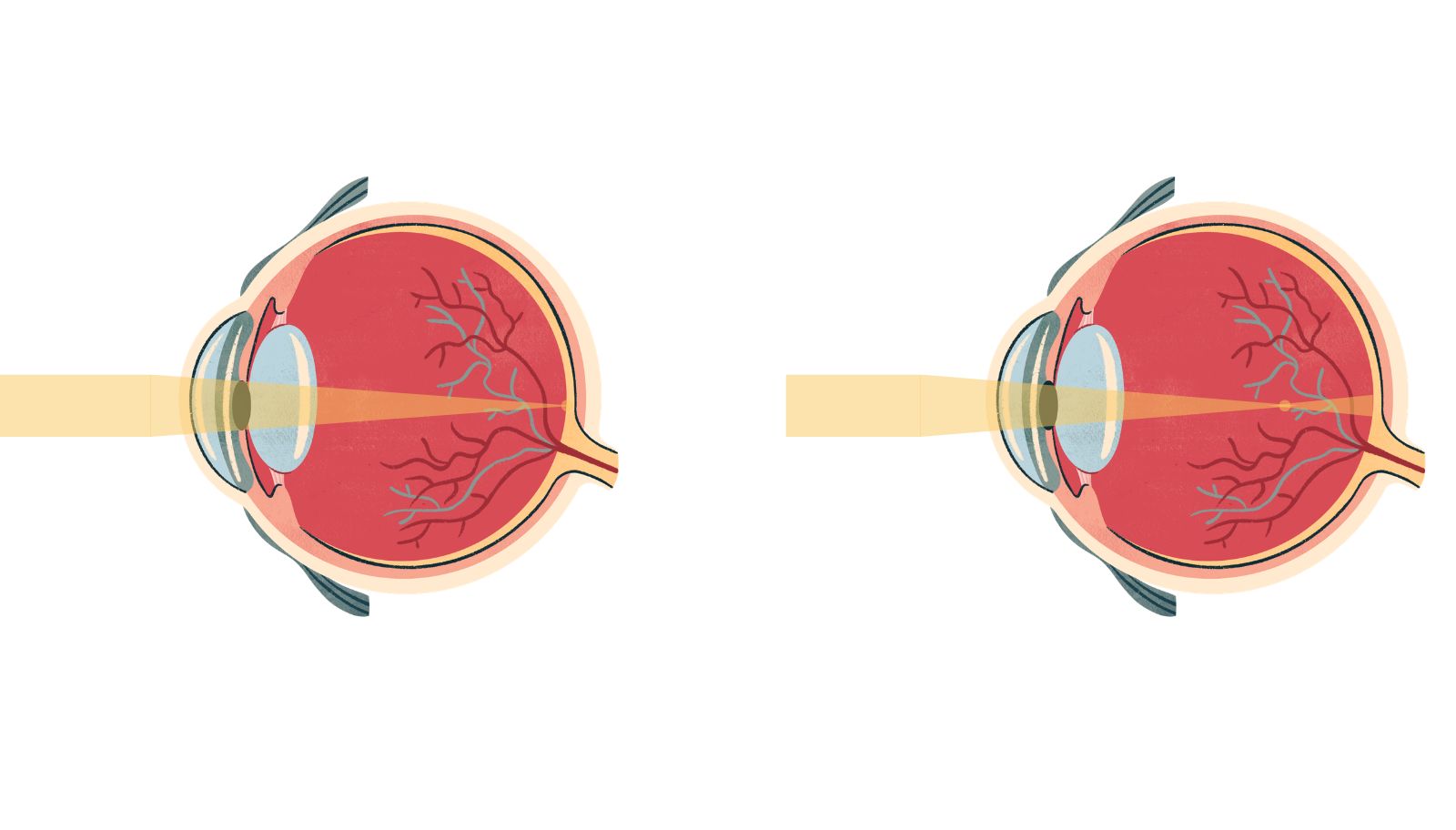 On the left is the normal condition, while on the right the focal point of light falls in front of the retina
Some individuals are born with an eyeball whose front-to-back axis is longer than normal, a structural difference often linked to heredity. If one or both parents have high myopia, their children are more likely to develop an elongated eyeball during growth.
Once the eyeball becomes excessively long, light passing through the cornea and lens focuses in front of the retina, causing distant images to appear blurred. This congenital structural abnormality of the eye typically emerges during childhood or adolescence and may worsen as the individual grows.
Refractive myopia, by contrast, is associated with the innate characteristics of the eye’s refractive system. In some people, the corneal curvature is steeper than normal, or the crystalline lens is unusually thick or shaped, resulting in excessive refractive power. Even when the eyeball length is normal, light entering the eye is over-focused, with the focal point falling in front of the retina.
In such cases, patients also experience blurred distant vision, but the underlying cause lies in a congenital imbalance of the optical refractive system rather than a change in eyeball shape.
In summary, the congenital influence on axial myopia stems from structural differences—specifically, an elongated eyeball—whereas the congenital influence on refractive myopia arises from excessive refractive power in the optical system. Although both lead to myopia, their physiological foundations are entirely distinct.
In axial myopia, prolonged near work is the primary cause. Activities such as extended reading, computer use, or smartphone viewing keep the eye in a constant state of accommodative strain, stimulating gradual elongation of the eyeball. A lack of outdoor activity and insufficient exposure to natural light further accelerate this process, since outdoor illumination helps regulate normal ocular development.
As the axial length increases, the focal point of light shifts farther in front of the retina, producing blurred distant vision. This structural change is typically irreversible, so axial myopia often progresses over time and may even lead to retinal disorders.
Refractive myopia, by contrast, is more closely related to functional changes in the refractive system. Insufficient outdoor activity or inadequate light exposure can impair the normal accommodative ability of the cornea and lens, gradually increasing refractive power. With age, the crystalline lens loses elasticity or undergoes changes in thickness, which can also cause excessive refraction, bringing the focal point forward in front of the retina.
Additionally, certain habits—such as prolonged use of the eyes in dim environments—may further burden the refractive system, leading to the onset or worsening of refractive myopia.
In other words, the acquired influence on axial myopia stems mainly from “structural elongation of the eyeball,” whereas the acquired influence on refractive myopia arises from “changes in refractive power of the optical system.” Although both result in blurred distant vision, their underlying mechanisms differ, reflecting the profound impact of lifestyle and environment on visual health.
The progression of axial myopia can be understood as the eyeball gradually entering a state of “permanent adaptation” under prolonged near work.
Under normal circumstances, the structure of the eye maintains a balance that allows light to be accurately focused on the retina. However, when a person spends extended periods focusing on close objects—such as reading, using a computer, or looking at a phone—the eye must constantly adjust its focal length to maintain clear vision. This sustained strain stimulates the eyeball to elongate, leading to axial myopia.
At first, the elongation is slight, and the degree of myopia may be mild. Yet with the accumulation of near work, the eyeball gradually “adapts” to this condition, its structure forced to change so that the focal point consistently falls in front of the retina.
This alteration is not temporary; physiologically, the eye enters a state of “permanent adaptation”: it no longer returns to its original length but remains fixed in an elongated form.
Over time, this permanent adaptation causes the degree of myopia to deepen, progressing from mild to moderate and even severe myopia. More critically, excessive elongation of the eyeball stretches the retina and choroid, increasing the risk of retinal tears, detachment, or macular degeneration.
In other words, the progression of axial myopia represents a shift from “functional adjustment” to “structural change,” ultimately leaving the eyeball permanently altered under the pressure of long-term near work.
Current treatment methods for myopia are generally divided into two categories: optical correction and surgical correction. These approaches serve different purposes—optical correction improves vision through external aids, while surgical correction directly alters the refractive structure of the eye.
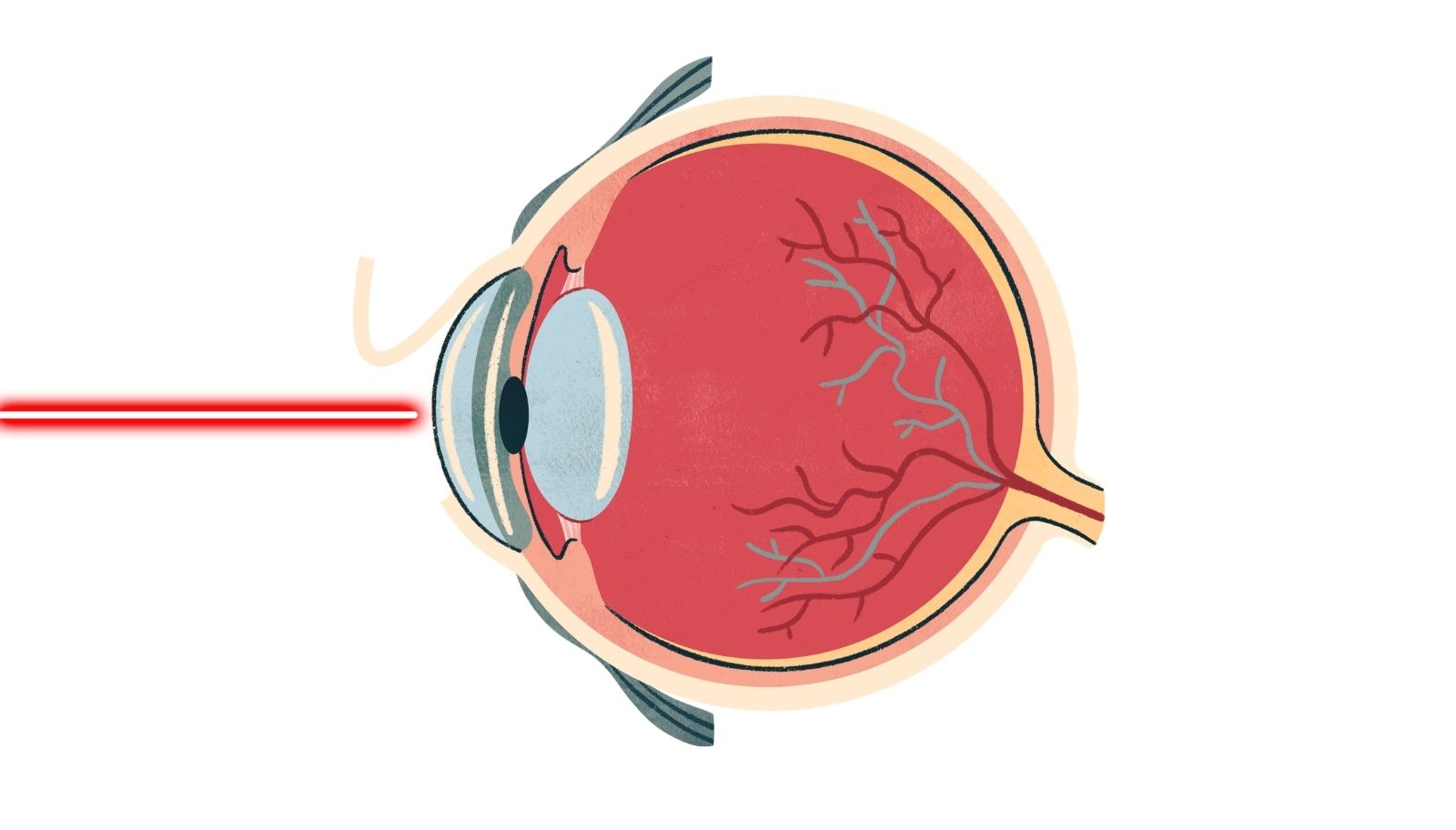 LASIK requires lifting the corneal flap and reshaping the corneal stroma with a laser
Preventing myopia does not rely on a single method; it requires a comprehensive approach involving lifestyle habits, environment, and patterns of eye use.
Preventing myopia does not rely on a single method; it requires a comprehensive approach involving lifestyle habits, environment, and patterns of eye use.
In summary, the key to preventing myopia lies in “reducing excessive strain on the eyes” and “promoting normal development.” Through outdoor activity, reasonable eye use, a healthy environment, and balanced lifestyle habits, the onset and progression of myopia can be effectively reduced.
In myopia, light passing through the cornea and lens focuses in front of the retina, causing distant images to appear blurred. Hyperopia, by contrast, occurs when the focal point falls behind the retina, making nearby objects difficult to see clearly.
There are several causes for this condition. The most common is that the eyeball’s front-to-back axis is too short, so light reaches the retina before it has fully converged, resulting in a blurred image. Another cause is insufficient refractive power, due to a cornea that is too flat or a crystalline lens that is too weak. In such cases, light cannot be adequately focused on the retina.
These structural differences may be congenital, but they can also worsen with age—for example, as the lens gradually loses elasticity, the eye’s ability to adjust focus diminishes, making it harder to bring the focal point back onto the retina.
Thus, hyperopia can be understood as the result of either a “shortened eyeball” or “insufficient refraction.” It is the opposite of myopia: in myopia, the focal point falls prematurely in front of the retina, while in hyperopia, it falls behind. This distinction explains why myopic individuals see nearby objects clearly but distant ones blurred, whereas hyperopic individuals see distant objects relatively clearly but struggle with near vision.
 Looking at distant objects can effectively relax the eyes
We leverage big data to bring you the most fascinating and mind-blowing trivia. Follow us for regular updates—prepare to be amazed while leveling up your knowledge.


Tattooing is a form of bodily marking that has carried multiple meanings throughout human history. In ancient societies, it could signify religious devotion, serve as a symbol of tribal identity, or

In today’s society, motors are virtually everywhere. They drive robotic arms in factories, keeping production lines running at high speed; they power elevators and automatic doors, making urban life

There are many different kinds of vinegar in the world, ranging from fruit vinegar and rice vinegar to wine vinegar and white vinegar, each with its own distinctive flavor and use. Fruit vinegar

The chicken’s body is likewise covered with feathers and equipped with wings, giving the outward impression of being suited for flight. Yet why is it that they cannot soar into the sky like other

Eggs are a highly nutritious food. They contain high‑quality protein that provides the essential amino acids required by the human body. The yolk is rich in vitamins A, D, E, and K, as well as

Durian, hailed as the “King of Fruits,” is renowned for its thick, spiky shell and its powerful aroma. Its appearance serves both as a natural defense and a sign of ripeness, while its distinctive

Christianity, Catholicism, Orthodoxy and Protestantism Christianity is a faith centered on Jesus Christ, emphasizing salvation and the relationship with God. It is also one of the religions with

In human society, the most immediate differences often arise from appearance. Walking down the street or browsing through historical images, we find that human looks display astonishing diversity.



Follow us for quirky updates, fun discoveries, and a front‑row seat to the weird and wonderful world we live in.