
All things in the world are composed of atoms, which are the fundamental units of matter. At the core of each atom lies the nucleus, containing positively charged protons and electrically neutral neutrons. These particles are tightly bound together by the strong nuclear force, forming a stable atomic nucleus. Surrounding the nucleus are negatively charged electrons, distributed across different energy levels in electron clouds. The number of electrons balances the number of protons, keeping the atom electrically neutral under normal conditions. When multiple atoms form chemical bonds through the sharing or transfer of electrons, they combine into molecules. In simple terms, protons and neutrons make up the heart of the atomic nucleus, while electrons accompany the nucleus externally. Together, they constitute the complete structure of the atom, and atoms further combine into molecules, creating the material world we see.
Electrons are fundamental particles carrying negative charge. Within atoms, they usually orbit around the nucleus, maintaining overall neutrality. However, when an external electric field or potential difference is applied, electrons can be driven away from atoms or set into motion within a conductor. This organized movement of a large number of electrons in a specific direction is what we call electric current. In other words, current is not an independent substance, but rather the macroscopic manifestation of electrons continuously moving through conductors or ionized gases. The microscopic motion of electrons, driven by an electric field, produces the macroscopic phenomenon of current, allowing energy to be transmitted through circuits.
When an external power source (such as a battery or generator) establishes a potential difference, it creates regions of high and low energy at the ends of a conductor. The electric field spreads through the conductor, pushing free electrons into motion. These electrons, which were originally moving randomly, become organized under the influence of the field, flowing overall from the negative terminal toward the positive terminal. As electrons continue to move, energy is transferred along with them, powering components in the circuit, such as lighting a bulb or driving a motor. Finally, the external power source continuously supplies energy to maintain the potential difference, ensuring the sustained flow of electrons. This is the complete process of how electric current operates.
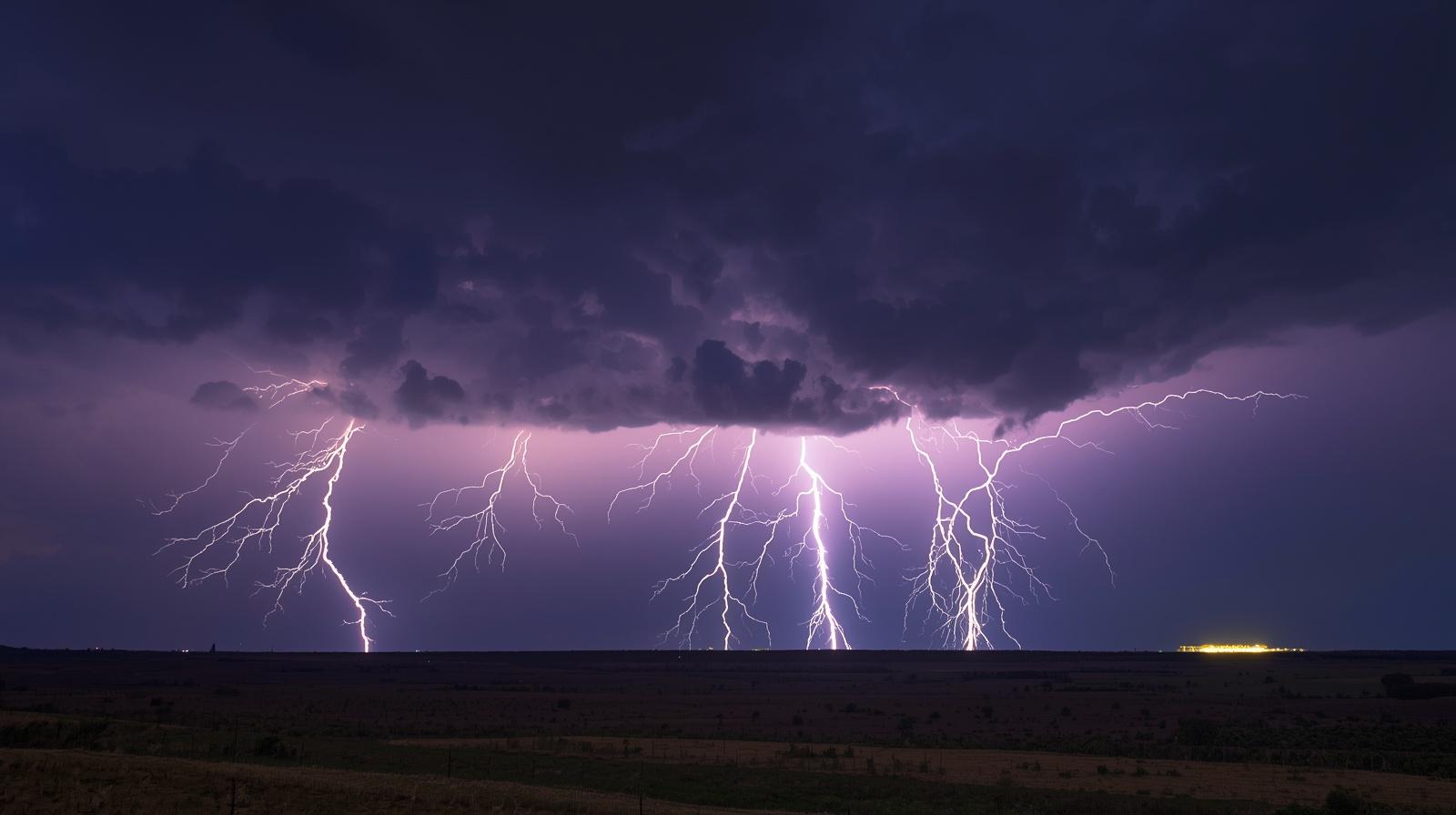
Inside a thundercloud, the air is filled with water droplets and ice crystals, which are constantly colliding due to strong updrafts and downdrafts. These collisions are not merely mechanical contacts but involve charge transfer: when larger ice particles or droplets collide with smaller ice crystals, electrons often shift from one to the other. Typically, the smaller, lighter ice crystals lose electrons and become positively charged, while the larger, heavier particles gain electrons and become negatively charged. Because the heavier particles tend to sink, they accumulate near the bottom of the cloud, creating a region rich in negative charge. Meanwhile, the lighter ice crystals are carried upward by rising air currents, taking positive charge with them and forming a positively charged region at the cloud top. In this way, the thundercloud develops a layered charge structure: negative at the base, positive at the top, and a massive potential difference with respect to the ground.
The electric field generated by these electrons extends downward toward the ground, influencing the surface through electrostatic induction. The ground, normally neutral, experiences a redistribution of its free electrons under the strong field: electrons are repelled deeper or farther away, leaving behind a relative concentration of positive charge near the surface. This positive region is not due to protons escaping, but rather the absence of electrons, creating an area deficient in negative charge. As the potential difference between the negatively charged cloud base and the positively charged ground intensifies, the electric field strength approaches the critical threshold needed to break down air’s insulating properties.
When the field strength exceeds the breakdown limit, air molecules become ionized, forming conductive channels. Electrons rush through these channels toward the ground, releasing enormous energy. Part of this energy appears as light: molecules, once excited, return to their ground states and emit photons, producing the brilliant flash of lightning. At the same time, the current heats the air to tens of thousands of degrees in an instant, causing violent expansion and generating shock waves. These shock waves propagate through the atmosphere as the sound we hear as thunder. Because lightning channels are long, sounds from different distances overlap, creating the rolling rumble of thunder.
Magnificent mountain ranges bring unique landscapes to Earth. Towering peaks that reach into the clouds were once flat land. How do they rise from underground and soar into the sky? Let us first

In daily facial care, many skincare brands and beauticians often emphasize the need for regular exfoliation. But what exactly are we removing when we exfoliate? Is it truly necessary? And what

Acne is a troublesome condition. Not only is it painful to the touch, but it also affects appearance. When acne becomes severe, it can undermine self-confidence and have a major impact on daily life

What culture and thought did the Renaissance truly aim to revive? Why did the course of history bring about the necessity of such a “rebirth”? And what form did human society take during the Middle

Christianity, Catholicism, Orthodoxy and Protestantism Christianity is a faith centered on Jesus Christ, emphasizing salvation and the relationship with God. It is also one of the religions with

Follow me for quirky updates, fun discoveries, and a front‑row seat to the weird and wonderful world we live in.