

The tender green of spring, the heat of summer, the golden hues of autumn, and the chill of winter—people have long grown accustomed to this cycle. Yet how many have paused to wonder: what force lies behind the creation of such a phenomenon?
Rotation is the Earth’s spinning motion around its own axis. The Earth, like a vast sphere, rotates continuously along an imaginary line passing through the North and South Poles. Each full rotation takes about 24 hours. This movement produces the alternation of day and night: when one hemisphere faces the Sun it experiences daylight, while the opposite side is in darkness. The rotation proceeds from west to east, which is why we see the Sun rise in the east and set in the west. Rotation also causes the Earth’s shape to be slightly flattened—bulging at the equator and compressed at the poles.
Revolution refers to the Earth’s motion around the Sun. The Earth’s orbit is nearly elliptical, and completing one circuit takes about 365 days, which defines a year. The average orbital speed is roughly 30 kilometers per second. This rapid motion ensures that the Earth remains bound by the Sun’s gravity, neither drifting away nor falling inward.
In simple terms, rotation establishes the rhythm of a “day,” while revolution sets the framework of a “year.” Together, these two motions create the familiar units of time and provide the stable environmental foundation upon which life on Earth depends.
The Earth’s axis of rotation is not perpendicular to the plane of its orbit around the Sun; instead, it is tilted by about 23.5 degrees. This tilt may seem subtle, but it is one of the most crucial characteristics of Earth’s motion.
Because of this inclination, the Northern and Southern Hemispheres do not face the Sun in the same way as the Earth spins. At certain points in its orbit, the Northern Hemisphere leans toward the Sun, receiving more direct sunlight, while the Southern Hemisphere tilts away; six months later, the situation reverses. This tilt causes variations in the angle and duration of sunlight across different latitudes throughout the year.
Moreover, the tilt is not a random occurrence but a remnant of external forces acting on Earth during its early formation. The stability of the axis is maintained by Earth’s angular momentum. Although there are slight long-term oscillations known as precession, the overall tilt remains relatively constant, ensuring predictable environmental patterns over millennia.
It is precisely this axial tilt that serves as the key to the existence of the four seasons on Earth.
The tilt of Earth’s axis most directly alters the angle at which sunlight strikes the surface. When the Sun’s rays arrive at a nearly vertical angle, the same amount of energy is concentrated over a smaller area, so the ground absorbs heat more intensely and temperatures rise—this is the hallmark of summer. Conversely, when sunlight arrives at a shallow angle, the energy spreads across a wider area, reducing heating efficiency and producing colder conditions, characteristic of winter.
In addition, the angle of sunlight affects the length of its path through the atmosphere. Rays that strike vertically travel almost straight to the surface, losing little energy along the way. Slanted rays, however, must pass through a thicker layer of air, undergoing more scattering and absorption, so less energy reaches the ground. This difference further amplifies the contrast between warm and cold seasons.
Beyond energy distribution, the angle of sunlight also governs the duration of daylight. When the Sun climbs high in the sky, the angle is large, and daylight hours are extended while nights are shortened. When the Sun remains low, the angle is small, daylight is brief, and nights are long. This variation in day length intensifies the seasonal differences.
For example, in the Northern Hemisphere during summer, the Sun’s rays strike at a steep angle, days are long, and energy is concentrated, making the climate hot. In winter, the rays arrive at a shallow angle, days are short, and energy is dispersed, resulting in cold conditions. The Southern Hemisphere experiences the opposite pattern, creating the alternating cycle of seasons.
If Earth had no axial tilt, the very idea of seasons would vanish.
In such a scenario, sunlight would strike each latitude at nearly the same angle throughout the year. The equatorial regions would remain hot due to direct overhead rays, but mid- and high-latitude areas would no longer experience the steep angles of summer or the shallow angles of winter.
In other words, both hemispheres would lose the alternation of spring, summer, autumn, and winter, settling instead into a relatively uniform climate. Every one of the 365 days would feel like the same season. Taiwan and Hong Kong would be locked in a “perpetual spring-autumn” state—mild, humid, and slightly sticky—while Europe and Canada would remain in a cool, late-autumn climate forever.
Daylight hours would also become monotonous. Without axial tilt, the Sun’s daily rise and set positions would hardly change, and the length of day and night would remain constant. Everywhere on Earth (except at the poles), each day would be precisely twelve hours of daylight and twelve hours of darkness. The poetic rhythm of “long summer days and lingering winter nights” would disappear entirely.
Such an Earth, though seemingly more “stable,” would lose the diversity brought by seasonal change. Agricultural cycles would be disrupted, plants and animals would alter their reproductive patterns, and human life would no longer follow the natural rhythm of sowing in spring, growing in summer, harvesting in autumn, and storing in winter. More critically, this uniformity could trigger ecological collapse and widespread outbreaks of disease, as ecosystems depend on seasonal variation to maintain balance.
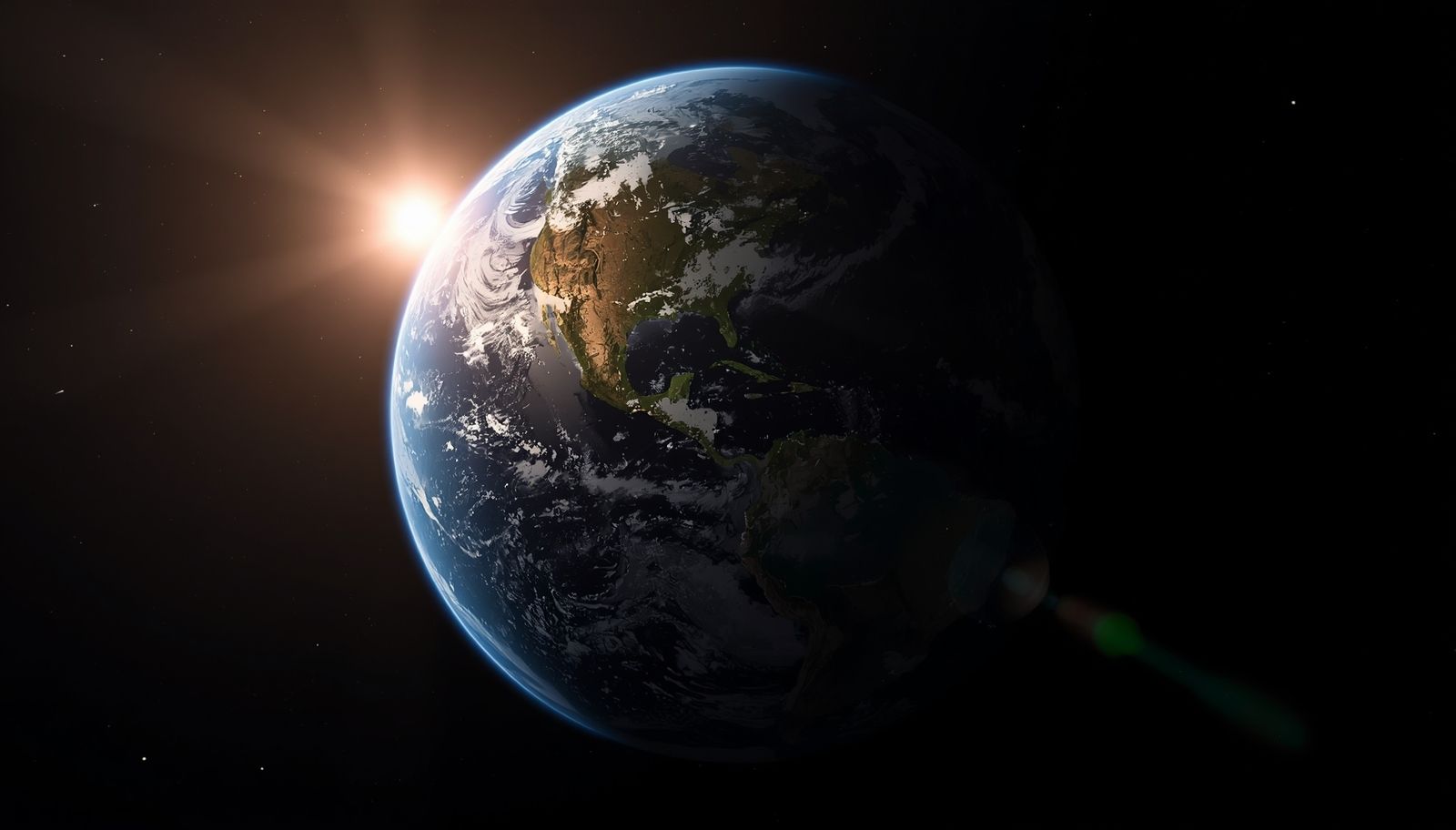 The region where sunlight falls directly is experiencing the height of summer
Earth’s orbit around the Sun is not a perfect circle but an ellipse. The Sun is not located at the exact center of this ellipse; instead, it is offset toward one side. This means that when Earth reaches the two ends of the ellipse, its distance from the Sun is unequal. These points are known as the perihelion and the aphelion.
Perihelion is the moment when Earth is closest to the Sun in its orbit. This usually occurs in early January, when the distance between Earth and the Sun is about 147 million kilometers. At this point, the Sun’s gravitational pull is slightly stronger, and Earth’s orbital speed increases. Although Earth is nearer to the Sun, this does not make the Northern Hemisphere warmer, because the seasons are determined primarily by the tilt of Earth’s axis, not by distance.
Aphelion is the position when Earth is farthest from the Sun, typically in early July, at a distance of about 152 million kilometers. Here, the gravitational pull is weaker, and Earth’s orbital speed slows down slightly. Despite being farther away, the Northern Hemisphere is in the midst of summer and remains hot, once again showing that distance is not the driving factor behind the seasons.
Although Earth’s distance from the Sun changes slightly during its orbit, this variation has far less impact on the seasons than the angle of sunlight. The reason is that the difference in distance is relatively small compared to the overall scale: the gap between perihelion and aphelion is only a few million kilometers, while the average Earth–Sun distance is about 150 million kilometers. Such a proportion is insufficient to produce dramatic temperature shifts.
By contrast, changes in the angle of sunlight directly affect how energy is distributed. When the Sun’s rays strike at a steep angle, the energy is concentrated, and the ground warms quickly. When the rays arrive at a shallow angle, the same energy is spread across a larger area, reducing heating efficiency. This variation in energy density caused by angle differences far outweighs the influence of distance changes.
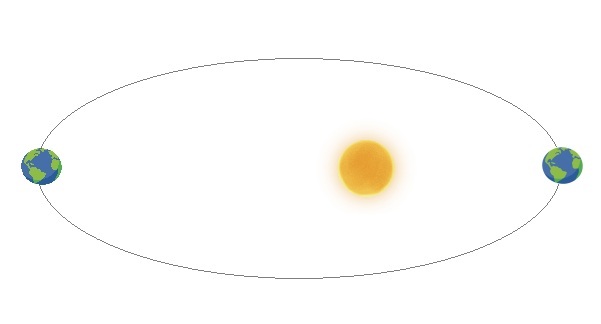 The distance between Earth and the Sun is not always the same
At Earth’s polar regions, there exists a remarkable phenomenon known as polar day and polar night.
When Earth’s tilted axis aligns with its orbital position in a certain way, the poles experience extended periods of either continuous daylight or continuous darkness. Take the Arctic as an example: when the Northern Hemisphere leans toward the Sun, the Sun never fully sets, even at midnight it lingers near the horizon. This is polar day, which can last for weeks or even months, meaning the entire summer passes without a true night. Conversely, when the Northern Hemisphere tilts away from the Sun, the Sun never rises, plunging the region into prolonged darkness—this is polar night.
In Antarctica, the situation is reversed. When the Arctic undergoes polar day, Antarctica is in polar night; six months later, the roles switch. This alternating cycle is a direct consequence of Earth’s axial tilt, ensuring that each pole spends half the year facing the Sun and the other half turned away.
Polar day and polar night are not only astronomical curiosities but also deeply shape life and human activity in these regions. Animals must adapt to months of constant light or darkness, while scientists working there face the challenge of disrupted circadian rhythms. These phenomena make the polar regions some of the most extraordinary places on Earth, vividly demonstrating the grandeur and uniqueness of the natural laws born from Earth’s tilted axis.
We leverage big data to bring you the most fascinating and mind-blowing trivia. Follow us for regular updates—prepare to be amazed while leveling up your knowledge.


Human sex is not only a fundamental biological trait but also a force that profoundly shapes the structure and functioning of society, influencing family roles, cultural norms, and institutional

In everyday life we often hear the terms “sugar” and saccharide,” “carbohydrate” and “starch.” These words appear similar, yet they are easily confused. Is sugar the same as carbohydrate? Is

Static electricity is a peculiar natural phenomenon. It seems to make objects cling to each other out of nowhere, and at times it suddenly releases energy, producing a sharp sting as if one has been

Magnetic Levitation (Maglev) trains are famous for their high speed, but how can such heavy trains float? And why do they need to float at all? ### Operating Principle A maglev train is a

For many people, trains are part of everyday life. Why is it that when you jump inside a train carriage, you land back in the same place instead of falling backward? And what happens if you jump on

A tornado is an extreme weather phenomenon, essentially a rapidly rotating column of air formed within intense convective thunderstorm clouds. When warm, moist air collides violently with cold, dry

The Renaissance was a cultural and intellectual movement that arose in Europe between the fourteenth and sixteenth centuries. It first unfolded in Italian cities such as Florence, Venice, and Milan,

Venice is a city in northeastern Italy, lying close to the Adriatic Sea. What makes it unique is that the entire city is composed of numerous small islands, separated by canals, linked by bridges,



Follow us for quirky updates, fun discoveries, and a front‑row seat to the weird and wonderful world we live in.