
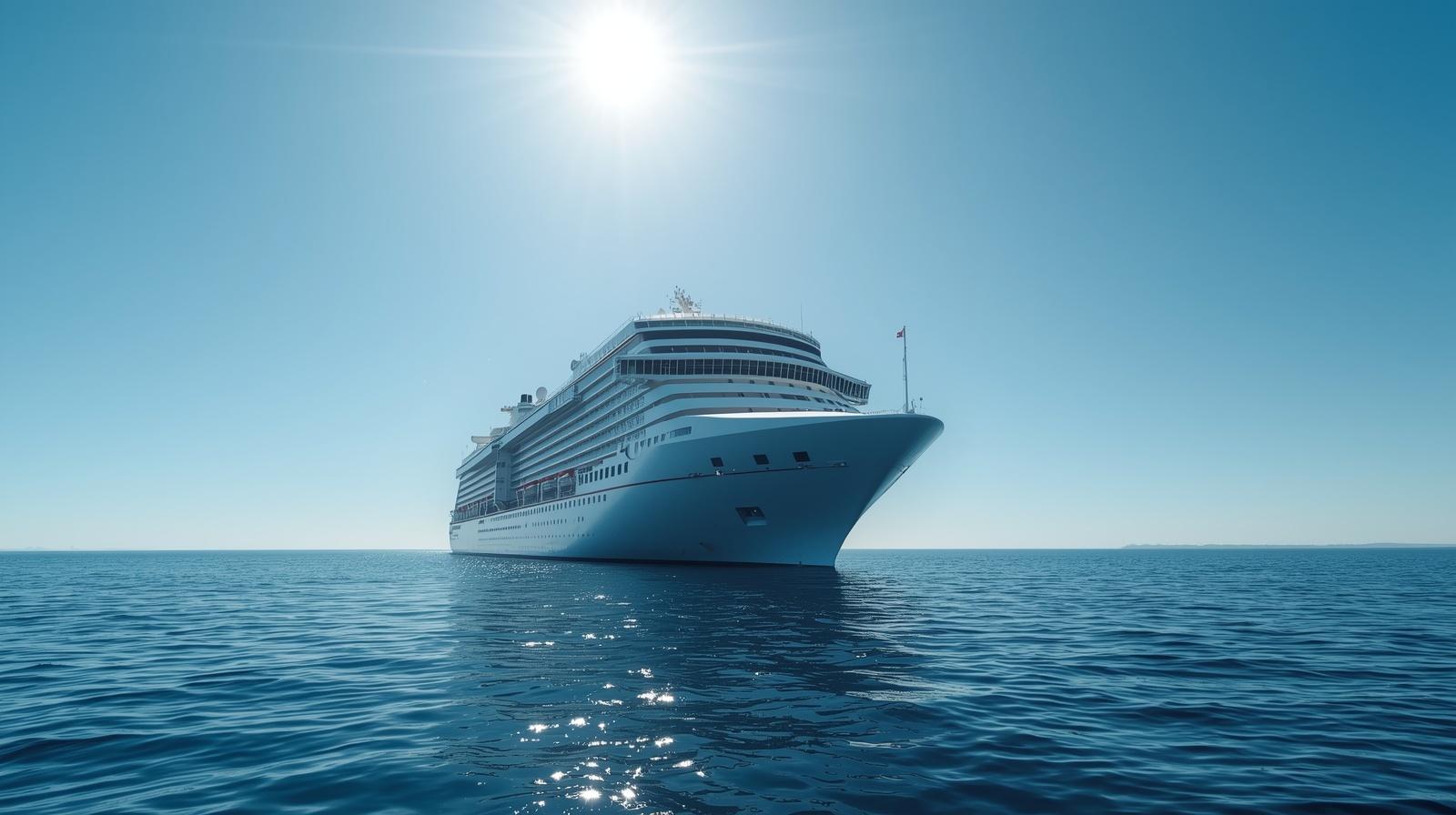
Giant cruise ships, cargo vessels, and oil tankers may weigh hundreds of thousands of tons, yet they can still travel freely across the sea. By contrast, a stone with a volume and weight far smaller than a ship sinks straight to the seabed—what explains this difference?
It is often observed that pieces of wood can float on water, while blocks of iron sink. Yet modern ships are almost entirely built of iron. Does this mean the material itself is not the decisive factor? What, then, determines whether something floats or sinks?
Archimedes’ principle, also known as the law of buoyancy, is the fundamental rule that explains whether an object can float in a liquid. It states: when an object is immersed in a liquid, the liquid exerts an upward buoyant force on it, and the magnitude of this force is exactly equal to the weight of the liquid displaced by the object. In other words, whether an object floats in water depends on whether the weight of the displaced liquid is sufficient to balance its own weight.
The applications of Archimedes’ principle can be observed in many everyday situations. For example, when you place a grape in a glass of water, it sinks because the weight of the displaced water is not enough to counteract the grape’s weight. But if you put the grape into concentrated salt water, it floats, since the higher density of salt water increases the weight of the displaced liquid, thereby enlarging the buoyant force.
Another example is an ice cube floating on the surface of water, which is also a manifestation of Archimedes’ principle. When the ice cube is immersed, the buoyant force exerted by the water is exactly equal to the weight of the displaced water. Because ice has a lower density than water, the buoyant force is sufficient to support part of its weight, leaving a portion of the ice cube exposed above the surface.
Average density is a concept used to measure the overall “distribution of weight” of an object. It is calculated by dividing the object’s total mass by its total volume, yielding an average value. This figure reflects how the object behaves under buoyant force in a liquid, rather than just the density of one particular material within it.
When determining whether an object floats or sinks, average density plays a decisive role. If an object’s average density is less than that of the liquid, the weight of the displaced liquid will provide enough buoyant force to support it, allowing the object to float. Conversely, if the average density is greater than the liquid’s density, the buoyant force will be insufficient to counterbalance the object’s weight, and it will sink.
For instance, a hollow sphere filled with air may have a shell made of a relatively dense material, but because its interior is empty, its overall average density is lower than that of water, enabling it to float. A solid block of metal, however, has an average density far greater than water, so it sinks immediately when placed in it.
Ships, though enormously heavy, float for the same reason: their structural design and control of average density. Average density is calculated by dividing the ship’s total mass by its total volume. Although the hull is built from steel, a dense material, the ship is not solid—it is hollow, with numerous compartments and spaces filled with air. This drastically reduces the overall average density.
When the ship enters the water, it displaces a certain volume of water. According to the law of buoyancy, the upward force exerted by the water equals the weight of the displaced water. If the ship’s average density is lower than that of water, the displaced water’s weight is sufficient to balance the ship’s weight, and buoyancy keeps it afloat. This explains why even massive steel ships, provided they are properly designed, can safely remain on the surface of the sea.
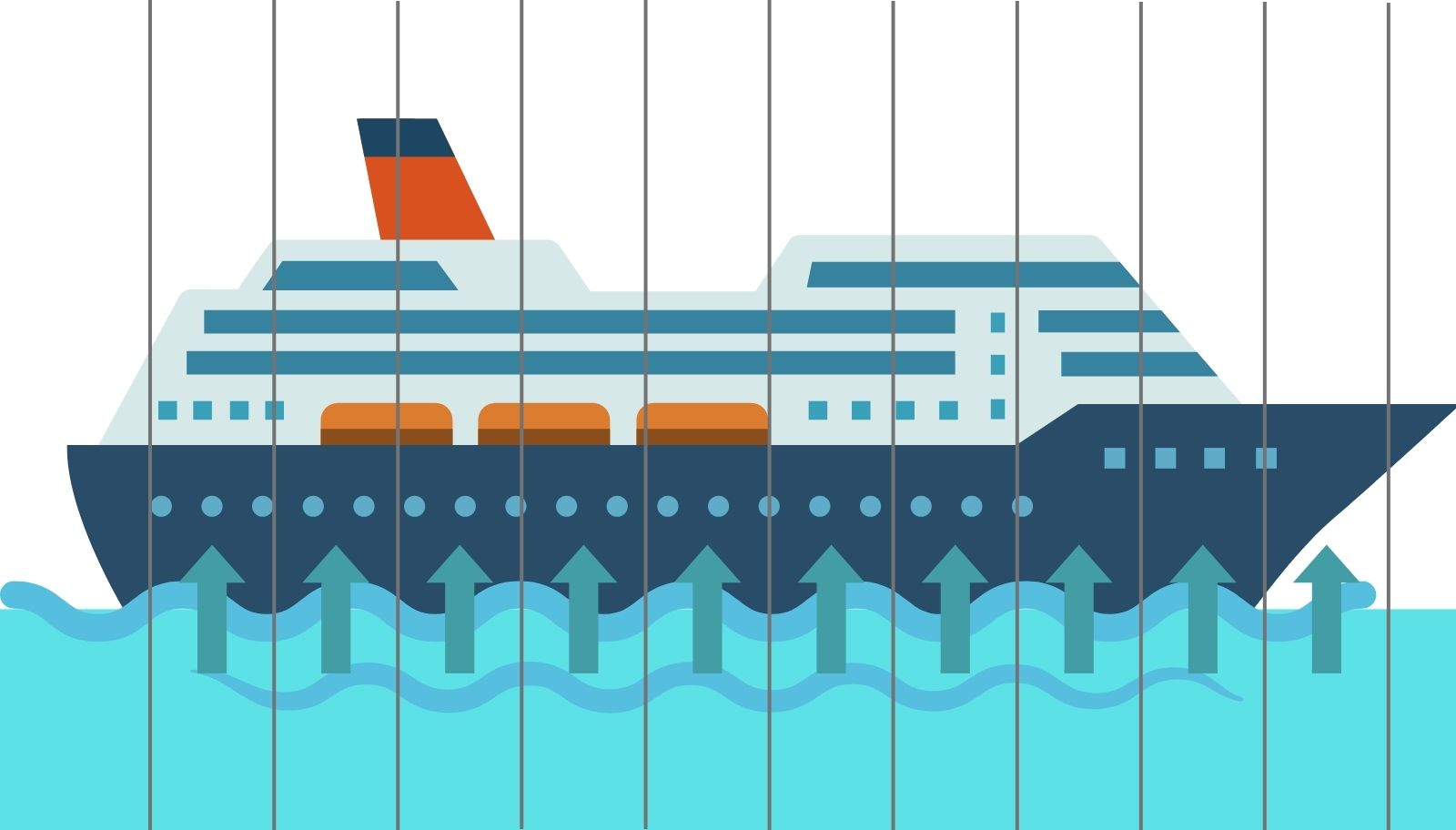 The density of a ship is not uniform throughout; as long as its average density is lower than that of water, it will float. The lower‑density parts of the hull offset the weight of the higher‑density sections.
Displacement refers to the weight of the water displaced by a ship when it is in the water. As the ship enters, it presses down the surface and pushes aside a certain volume of water; the weight of this displaced water is what we call displacement. According to Archimedes’ principle, the buoyant force acting on the ship is exactly equal to the weight of the displaced water, so displacement directly reflects the buoyant force the ship experiences.
The role of displacement is highly significant, and its most direct function is that it allows us to determine the ship’s weight. When a ship is floating, its weight must be balanced by the buoyant force, which is determined by the displacement. In other words, the condition for stable flotation is that the ship’s weight equals the weight of the water it displaces. Therefore, by measuring how much water a ship displaces, we can accurately calculate its weight.
Beyond indicating a ship’s weight, displacement is also a core parameter in naval architecture and marine engineering. It helps engineers plan the vessel’s carrying capacity, stability, and safety, and it serves as a basis for comparing the scale and function of different types of ships. Through displacement, people can not only grasp the weight of a vessel but also ensure that it remains safe and stable when fully loaded or underway.
Whether a ship can float depends not only on its own design and average density, but also on the properties of the water itself. Different bodies of water, due to variations in composition and density, directly affect the magnitude of buoyant force.
In river water, the density is close to that of pure water, so the buoyant force is relatively standard. For an object to float, its average density must be lower than that of the river water; otherwise, it will sink. This is why in freshwater lakes or rivers, people often need to adjust their posture carefully to stay afloat.
Seawater, by contrast, contains salt and has a higher density than freshwater. When the same object is placed in seawater, the weight of the displaced water is greater than in river water, which means the buoyant force is stronger. As a result, ships or people float more easily in seawater than in freshwater, and ships can even carry more weight without sinking.
The Dead Sea is an extreme example. Its salt concentration is extraordinarily high, giving it a density far greater than ordinary seawater. Consequently, the buoyant force is exceptionally strong. A person in the Dead Sea can float effortlessly on the surface even without knowing how to swim. For ships, such a high-density body of water provides so much buoyancy that sinking becomes virtually impossible.
A submarine is able to control whether it floats or sinks in water by means of its specialized structural design and buoyancy regulation system. The underlying principle is still Archimedes’ law of buoyancy, but the submarine makes use of “ballast tanks” to alter its average density, thereby determining its state in the water.
Ballast tanks are compartments that can be filled with or emptied of water. When the submarine needs to dive, seawater is allowed into the ballast tanks, increasing the vessel’s overall weight. Its average density then exceeds that of the surrounding water, the buoyant force becomes insufficient, and the submarine gradually sinks.
Conversely, when the submarine needs to surface, compressed air is used to expel the water from the ballast tanks, refilling them with air. This reduces the vessel’s weight, lowers its average density below that of seawater, and buoyancy lifts the submarine back to the surface.
Beyond basic ascent and descent, submarines can finely adjust the amount of water in the ballast tanks to achieve a state of “neutral buoyancy.” In this condition, the submarine’s weight and buoyant force are perfectly balanced, so it neither sinks nor rises, but remains suspended at a chosen depth. This capability is crucial for military operations and underwater exploration, as it allows the submarine to stay concealed and stable beneath the surface.
Thus, a submarine’s ability to control floating and sinking does not rely on propulsion, but rather on the clever use of ballast tanks to alter average density, keeping the balance between buoyancy and weight continuously adjustable. This design enables submarines to maneuver flexibly underwater, capable of deep exploration as well as safe return to the surface.
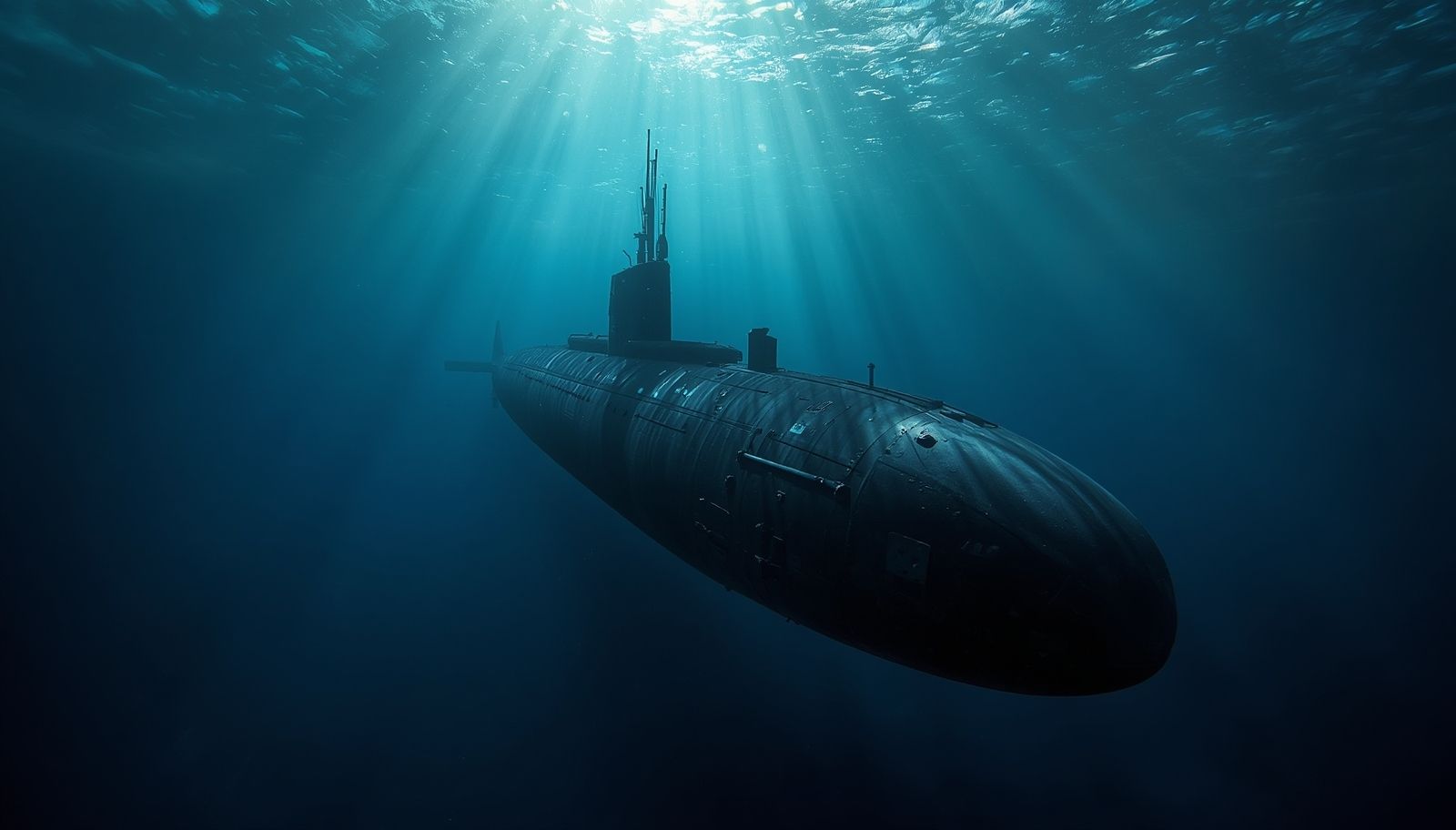 Submarines must precisely control their buoyancy to execute missions.
We leverage big data to bring you the most fascinating and mind-blowing trivia. Follow us for regular updates—prepare to be amazed while leveling up your knowledge.


The most captivating aspect of twins lies in their striking resemblance in appearance. When encountering twins in a crowd, the first impression is the shock of seeing two faces that look almost

Lightning is a sudden and violent natural discharge phenomenon. It usually appears as a brilliant streak of light cutting across the sky, either between clouds or from cloud to ground. Its shape is

Throughout the course of human history, the spread of electricity has symbolized a leap in civilization. Its emergence not only provided an entirely new source of energy but also fundamentally

Many people tend to confuse “bacteria” and “viruses” when talking about them. Some believe that a common cold must be caused by a bacterial infection and that taking antibiotics will cure it; others

The current global situation of myopia has become a significant public health issue. With the advance of urbanization and the widespread use of technology, human lifestyles have undergone profound

Cancer often strikes fear because it is not merely a disease, but a force that can completely alter the course of a person’s life. Once someone is diagnosed, the focus of daily living shifts

Christianity, Catholicism, Orthodoxy and Protestantism Christianity is a faith centered on Jesus Christ, emphasizing salvation and the relationship with God. It is also one of the religions with

In the human world, rest and sleep are essential to life. Humans, mammals, and even most fish can conserve energy by remaining still. Yet in the vast ocean, there exists a group of creatures that can



Follow us for quirky updates, fun discoveries, and a front‑row seat to the weird and wonderful world we live in.